
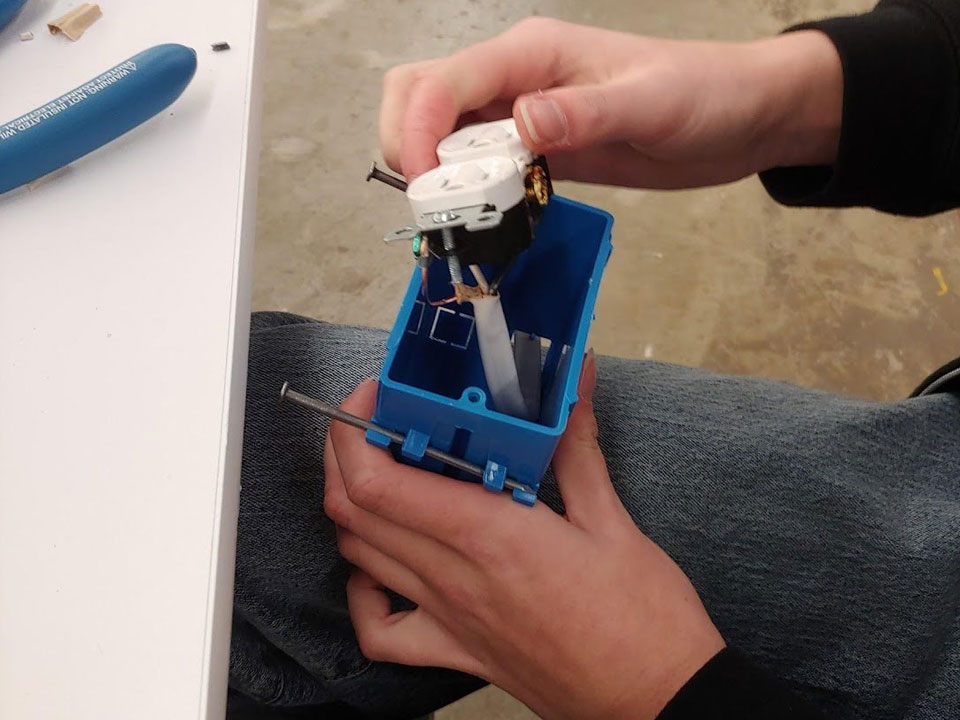
Phenomena: A Three-prong Plug
Ask Students: “We know we only need two wires for a light bulb to light up (hot and neutral). What is the purpose of this third, rounded prong?” Introduce the term Ground (Earth).
Introduce the Analogy (The River Diverter):
Water (Electricity): Needs a path to flow.
Normal Path (Neutral): The river’s main channel.
Flood (Fault): The river overflows and hits the appliance casing.
Human Body (Skinny Straw): A slow, high-resistance path for the water/electricity. It can still drain the flood, but it will cause damage (shock/electrocution).
Learning Goals:
- Students will know what each wire does in an outlet.
- Students can effectively use wire strippers and cutters.
- Students understand the purpose of a ground wire and know its safety considerations.
Materials List
Handouts
Pair Supplies
- 1 ft of 14/2 Romex wire
- 1 single gang box
- 1 electrical outlet
- Screwdriver
- Wire strippers
- Utility knife
Important Links
- Lesson Plan
- Kahoot Pre-Test (login required)
- All About Circuits’ Safety Grounding Worksheet (With Answers)
- YouTube Video: Why some power plugs have 3 prongs instead of 2
- YouTube Video: Electorcutions and Electric Shock Injuries
- YouTube Video: How Do I Get Shocked? Why Am I Getting Shocked? It’s Simple (language warning 3:32 & 3:43, may need to mute/turn off captions)
- YouTube Video: What is Ground? Earth Ground/Earthing
- YouTube Video: Why Do We Use Ground Rods?
- YouTube Video: How To Wire An Electrical Outlet – EASY Receptacle Wiring STEP BY STEP
- YouTube Video: How Pros Wire Receptacles in 2025 (Future Proof)
Next Generation Science Standards
Next Generation Science Standards
- HS-PS3-1 (Energy): Create a computational model to calculate the change in the energy of one component in a system when the change in energy of the other component(s) and energy flows in and out of the system are known.
- HS-PS3-2 (Energy): Develop and use models to illustrate that energy at the macroscopic scale can be accounted for as a combination of energy associated with the motion of particles (objects) and energy associated with the relative positions of particles (objects).
- HS-PS3-3 (Energy): Design, build, and refine a device that works within given constraints to convert one form of energy into another form of energy
- HS-PS3-5 (Energy): Develop and use a model of two objects interacting through electric or magnetic fields to illustrate the forces between objects and the changes in energy of the objects due to the interaction.