
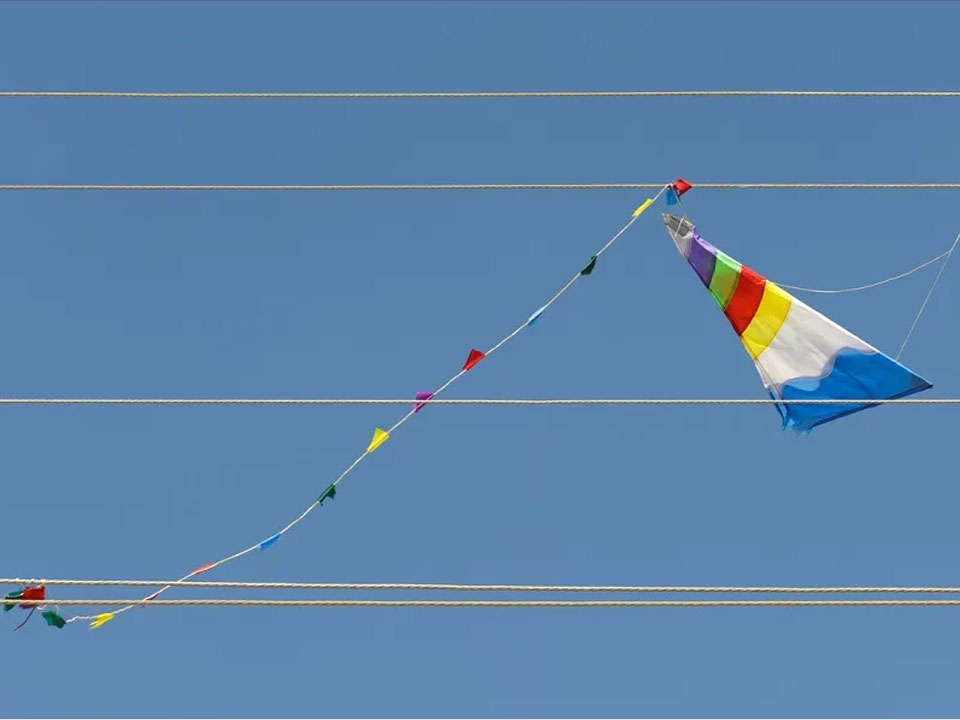
Phenomena: Kite on Powerlines
A kite becomes tangled in a power line and causes sparks or an electrical outage.
This real-world event prompts students to investigate why it happened and how electricity can travel through certain materials to cause harm.
Learning Goals
- Students will gain an understanding of electricity: including how it travels, the hazards associated with flying objects near powerlines, and the potential dangers electricity can pose.
- Students will learn how to identify safe and unsafe areas for outdoor recreational activities involving kites, drones, or model airplanes.
- Students will develop awareness and responsibility for personal and community safety around electricity.
Next Generation Science Standards
Next Generation Science Standards
- 3-5-ETS1-2: Generate and compare multiple possible solutions to a problem based on how well each is likely to meet the criteria and constraints of the problem.
- 4-PS3-2: Make observations to provide evidence that energy can be transferred from place to place by sound, light, heat, and electric currents.
- 4-PS3-4: Apply scientific ideas to design, test, and refine a device that converts energy from one form to another.
Lesson 1: Electricity is Moving
Students learn how electricity can move without being seen, and the fundamentals of energy transfer. In this lessons students will build a simple circuit to test if materials are electric conductors.
Lesson 2: Flying Dangers
Students will learn what happens when kites and drones come into contact with powerlines. Students will learn how electricity moves through powerlines and engage in a safety discussion.
Lesson 3: Safety PSA
This lesson builds on concepts learned on electricity and powerline safety.
Students will work in small groups to create a PSA or safety poster helping others to identify safe and unsafe places to fly their drones, model planes, or kites. They will share why powerlines can be dangerous for these activities.